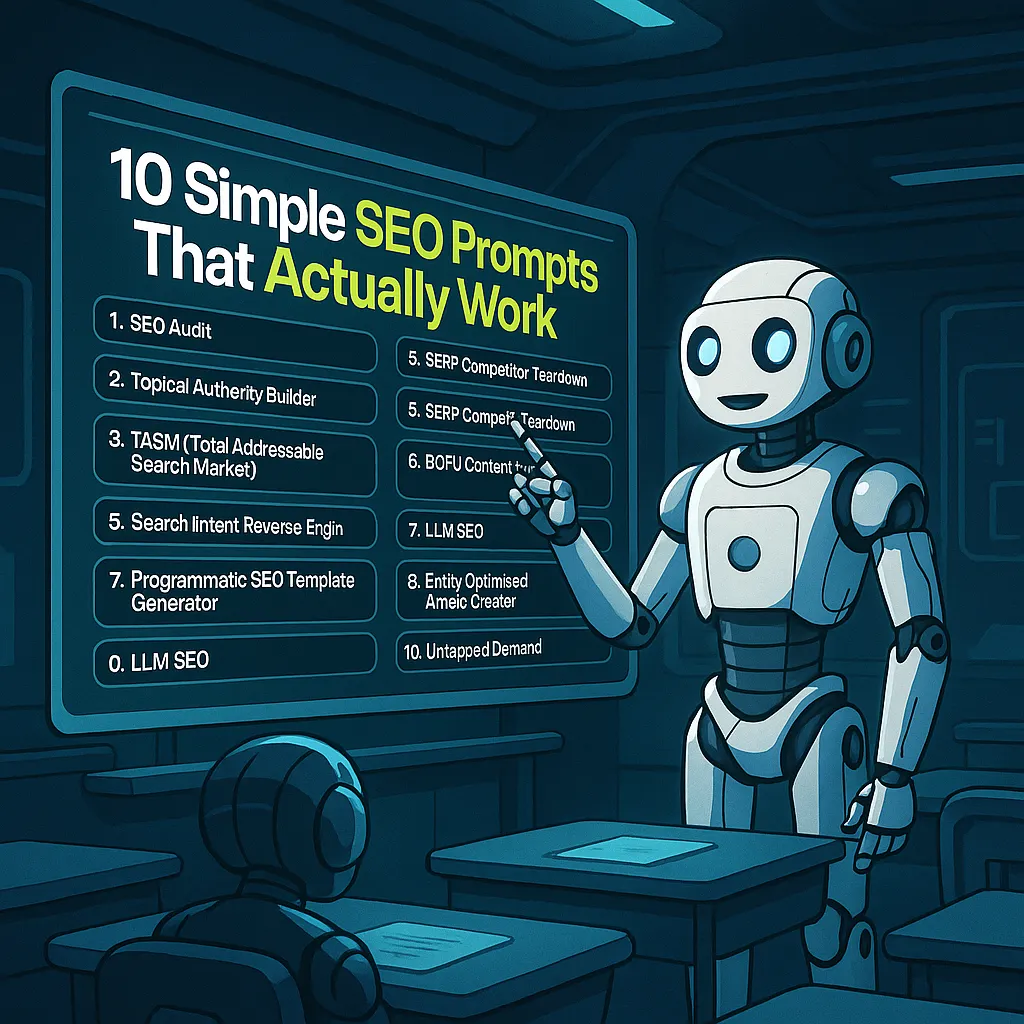
10 Simple SEO Prompts That Actually Work
Copy‑paste friendly prompts with concise explanations for audits, topical maps, BOFU content, SERP analysis, LLM optimization, and uncovering untapped demand. Built for fast deployment and reliable outcomes.
SEO Audit
Act as an expert SEO consultant. Audit the website (DOMAIN).
Identify key issues across technical SEO, content gaps, on-page optimization, backlinks, and UX.
Then prioritise top fixes and opportunities.
This prompt turns the AI into a comprehensive site auditor that connects technical health with business impact. It inspects crawlability, indexation, sitemaps, robots rules, structured data, and Core Web Vitals to surface blockers. It reviews information architecture and internal links to ensure authority flows to pages that matter. It scans for thin or duplicate content and highlights gaps where demand exists but coverage is missing. It checks titles, meta descriptions, headers, and media attributes so on‑page signals align with intent. It evaluates backlinks for authority, toxicity, and anchor diversity so risk and opportunity are clear. It considers UX factors like readability, accessibility, and conversion friction. It synthesizes findings into an ordered roadmap that teams can action immediately. It emphasizes quick wins while noting foundational fixes that support long‑term growth. It prevents random acts of SEO by aligning tasks to measurable outcomes. It is ideal for fast triage or quarterly planning.
Total Addressable Search Market
Help me define the Total Addressable Search Market for (PRODUCT/SERVICE/DOMAIN).
Group keywords into TOFU / MOFU / BOFU clusters.
Include intent, content types, and estimated opportunity.
This prompt maps the real size of your search opportunity rather than focusing on a few head terms. It clusters queries into awareness, consideration, and purchase so coverage lines up with buyer journeys. It annotates each cluster with user intent and the best content format to meet expectations. It estimates opportunity using volume and competitiveness to help prioritize what to publish first. It exposes long‑tail areas where you can rank quickly with targeted content. It de‑risks resource allocation by turning an unstructured list into a plan. It reveals where you have content gaps that cause leakage to competitors. It helps product, content, and performance teams work from the same shared map. It supports forecasting by tying clusters to potential traffic and conversions. It becomes the backbone of an annual or quarterly editorial calendar.
Search Intent Reverse Engineering
For the keyword "(KEYWORD)", analyse search intent.
Break it into primary and secondary user goals.
Suggest ideal content format, page structure, and CTA strategy.
This prompt prevents mismatched pages by clarifying what searchers truly want. It separates the core job to be done from adjacent sub‑tasks that still matter. It prescribes the right format such as tutorial, category, comparison, or product detail. It proposes an information hierarchy that places must‑have answers near the top. It recommends CTAs that feel natural for the intent rather than pushy or premature. It reduces pogo‑sticking by showing exactly what people expect to see. It improves conversion by pairing educational content with appropriate next steps. It guides writers and designers with a clear outline before production starts. It shortens review cycles because stakeholders see intent alignment upfront. It is a reliable way to raise quality while cutting waste.
Programmatic SEO Template Generator
Create a reusable SEO article template for "(KEYWORD FRAMEWORK)", designed for programmatic generation.
Include intro, modular blocks (tables, FAQs, lists), and recommended internal/external links.
This prompt enables quality at scale by defining a reusable blueprint for hundreds of pages. It includes modular building blocks such as feature tables, pros and cons, FAQs, and related links. It bakes in internal link targets so authority consolidates around pillars. It suggests outbound sources for credibility that also aid users who want more depth. It adds consistent metadata and heading patterns so SERPs read cleanly. It protects against thin content by forcing minimum viable depth across sections. It accelerates production by giving writers and automation a shared structure. It improves maintainability because updates can be rolled out to a template rather than page by page. It is especially effective for local, comparison, spec, and inventory‑style content. It helps teams win long‑tail queries without sacrificing usefulness.
Entity Optimised Article Creator
Write a long-form article for the keyword "(KEYWORD)".
Optimise for AI Overviews and semantic SEO.
Include entities, subtopics, FAQs, and a concise summary answer at the top.
This prompt structures content so both humans and AI systems understand it clearly. It encourages a concise answer block at the top to satisfy zero‑click expectations. It enumerates related entities and subtopics so coverage feels complete. It incorporates FAQs written in natural language to match conversational queries. It improves the likelihood of inclusion in AI Overviews by strengthening semantic signals. It helps search engines connect your article to a broader knowledge graph. It supports skim‑readers with scannable sections while rewarding deep readers with detail. It improves internal linking by clarifying how this page fits the larger topic map. It reduces duplication because each subtopic has a distinct job to do. It is a dependable way to build cornerstone assets.
SERP Competitor Teardown
Analyse the top 10 Google results for "(KEYWORD)".
Summarise shared features like structure, word count, format, visuals, and metadata.
Then suggest how to differentiate and outperform.
This prompt treats the SERP like a spec sheet for what wins now and what gaps remain. It catalogs patterns across headings, length, and on‑page elements you must at least match. It reviews visual usage and media types that improve engagement. It checks metadata conventions that drive higher click‑through rates. It reveals where sameness creates an opening for a better angle. It proposes differentiation through unique data, design, or audience segment focus. It keeps teams from reinventing the wheel while avoiding me‑too content. It guides briefing so writers know where to go deeper and where to be faster. It improves launch confidence because requirements reflect what the market rewards. It is the quickest way to de‑risk high‑effort content.
BOFU Content Finder
Act as a B2B SEO strategist. For the product/service "(YOUR PRODUCT OR OFFER)",
list 15 BOFU keywords that signal strong purchase intent.
Include variations like "best", "vs", "review", "alternative", "pricing", "tool", "agency", and buyer pain points.
This prompt concentrates on queries closest to revenue so sales content gets built first. It surfaces modifiers that reflect decision making such as pricing and comparisons. It exposes alternatives and pain‑point language that enables empathetic messaging. It suggests page types like comparison tables, ROI explainers, and implementation notes. It improves sales enablement by aligning organic content with objections. It bridges SEO and paid search by standardizing keyword families across channels. It supports partner and affiliate strategies through structured review content. It raises lead quality because visitors arrive with commercial intent. It shortens sales cycles by addressing blockers before contact. It gives product marketing a shared list of triggers to highlight.
LLM SEO
Optimise this article (LINK) for LLM platforms like ChatGPT and Google AI Overviews.
Ensure clear entity associations, direct answers, source credibility,
and formatting that’s easy to extract as a summary.
This prompt adapts pages for an AI‑assisted discovery world. It clarifies entity relationships so models can ground responses properly. It inserts crisp answer paragraphs that are easy to quote. It adds citations to high‑quality sources that boost credibility. It standardizes headings, lists, and tables so summaries extract cleanly. It reduces ambiguity by defining terms near first use. It increases the chance that your content is referenced in AI Overviews. It complements traditional SEO by emphasizing clarity over density. It guides writers to think in both human paragraphs and machine‑readable chunks. It makes your content resilient as interfaces evolve.
Untapped Demand
Act as an advanced SEO and product marketing strategist.
For the audience (TARGET AUDIENCE) and product (YOUR PRODUCT),
list 20 "zero-volume" or overlooked search queries that signal deep intent or pain.
These should be phrased in natural language, question-based, or problem-first.
Include use cases or scenarios.
This prompt finds high‑intent questions that keyword tools often miss. It listens for real phrasing that customers use when stakes are personal. It reveals micro‑jobs to be done that product and support teams can address. It leads to distinctive content that avoids crowded head terms. It enables community and email content that feels empathetic and specific. It uncovers ideas for features, bundles, or onboarding guides. It equips sales with discovery questions that mirror customer language. It strengthens knowledge bases with scenario‑driven entries. It makes SEO less about volume and more about usefulness. It is a reliable way to discover blue‑ocean angles.
Frequently Asked Questions
These concise answers help you deploy the prompts with confidence across audits, content planning, and AI Overviews. Each entry expands for quick mobile scanning.
How do I prioritize which prompt to run first
Start with SEO Audit to identify blockers and quick wins, then use TASM to plan coverage, followed by Intent Reverse Engineering for pages already in production. This sequence delivers momentum while shaping strategy.Can these prompts work for small sites
Yes. The same frameworks scale down. For smaller catalogs, the main benefit is focus and repeatable structure rather than volume of pages.How do I adapt content for AI Overviews without hurting traditional SEO
Use the LLM SEO prompt to add clear answers, entities, definitions, and citations while preserving depth. Clarity helps both models and human readers.What metrics should I watch after using these prompts
Track index coverage, impressions, CTR, conversions, and assisted revenue. For AI Overviews, monitor branded queries, referral mix, and engagement from informational pages.Glossary
- TOFU
- Top of funnel discovery and education that builds awareness and category understanding.
- MOFU
- Middle of funnel comparison and solution research where buyers evaluate approaches.
- BOFU
- Bottom of funnel decision making such as pricing, implementation, and alternatives.
- LLM
- Large language model used in AI systems that summarize, answer, and generate content.
- SXO
- Search experience optimization focused on intent alignment and frictionless journeys.
- AIO
- AI optimization that structures content clearly so models can extract and cite it.
- GEO
- Generative engine optimization that encourages AI systems to reference your work.
- AEO
- Answer engine optimization that delivers snippet‑level responses to common questions.
- E‑E‑A‑T
- Experience, expertise, authoritativeness, and trust signals that raise content quality.