Activate Sales with the AIDA Framework That Converts
The AIDA formula (Attention, Interest, Desire, Action) is more than a sales cliché. It's a timeless copy model that maps human attention to revenue. Here's how modern marketers and AI tools use it today.
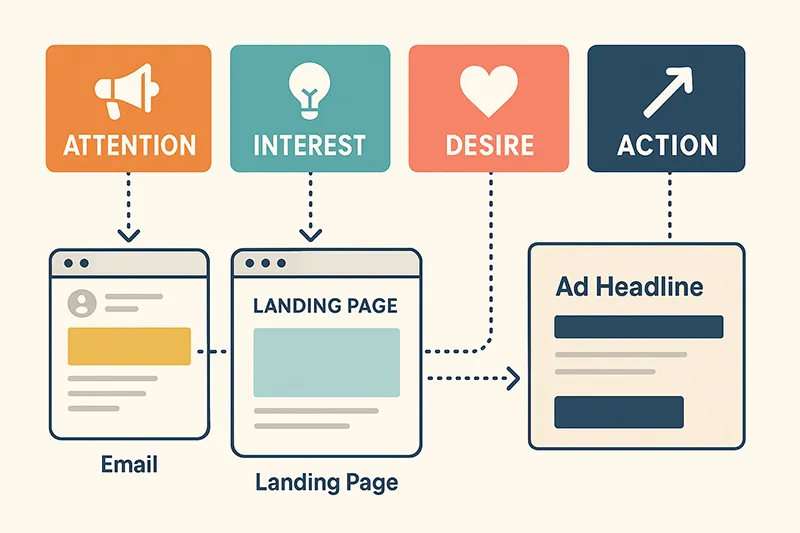
What makes AIDA effective in 2025 marketing?
Unlike vague positioning models, the AIDA framework is action-driven. It reflects the psychological arc a user experiences on the way to a click or conversion.
- Attention — Lead with an unexpected hook, image, or headline.
- Interest — Make the user lean in with proof, intrigue, or benefit language.
- Desire — Bridge to the reader's wants, problems, or outcomes.
- Action — Offer a no-brainer CTA that completes the motion.
This formula applies not just to human-written campaigns but also to prompt engineering for generative models like ChatGPT and Claude. They respond best when structure mirrors real intent behavior.
How brands use AIDA in the wild
Effective brands map AIDA to the medium. Here are examples from email, landing pages, and performance ads:
Performance Email for a SaaS Tool
- Attention: Subject line: "Struggling to keep clients updated?"
- Interest: "Most teams waste 7+ hours/week in status reports"
- Desire: "Our AI reports do it in 2 minutes—just connect Notion or Slack."
- Action: Try it free button with deadline badge
“When your copy matches what people feel but can't articulate, it converts. AIDA gives it shape.” — Copyhackers
How to use AIDA in AI prompt engineering
Prompts that clearly segment attention, interest, desire, and action generate more persuasive content. Train your AI to mirror emotional flow by embedding labels, triggers, and tone cues.
Write a LinkedIn post promoting [SERVICE] using AIDA. Label each line as: [A] [I] [D] [A] and include a short emoji headline at the start."Write 3 AIDA-formatted email intros for a fintech tool targeting B2B CFOs. Add urgency in the [D] section.What mistakes do marketers make with AIDA?
Skimming over 'Interest' and 'Desire'
Rushed campaigns often go from flashy hook to hard CTA, skipping emotional relevance. The result? Bounce, skim, delete. Don't forget:
- Interest earns the scroll
- Desire makes it personal
When training AI tools or building campaigns, force clarity at each step. Label your writing with [A] [I] [D] [A] until it's second nature.
Frequently Asked Questions
Can AIDA be used in short social content?
Yes. Even in a tweet or TikTok, you can grab attention, build interest with a hook, show a relatable benefit to spark desire, and wrap with a CTA.
How does AIDA help with AI writing prompts?
It improves prompt structure by mirroring real human flow. Models respond better when told exactly what each section should accomplish—hook, context, relevance, action.
Is AIDA still effective in 2025?
Absolutely. AIDA is more relevant than ever with AI-generated content, because it injects structure and persuasion where generic text would otherwise fail.