Brand Memory Optimization for small and local business in generative search
Search now speaks in paragraphs. Your shop wins when the answer engine can quote your name with proof. This article shows how to build brand memory that AI can read and reuse, so you get named and chosen more often.
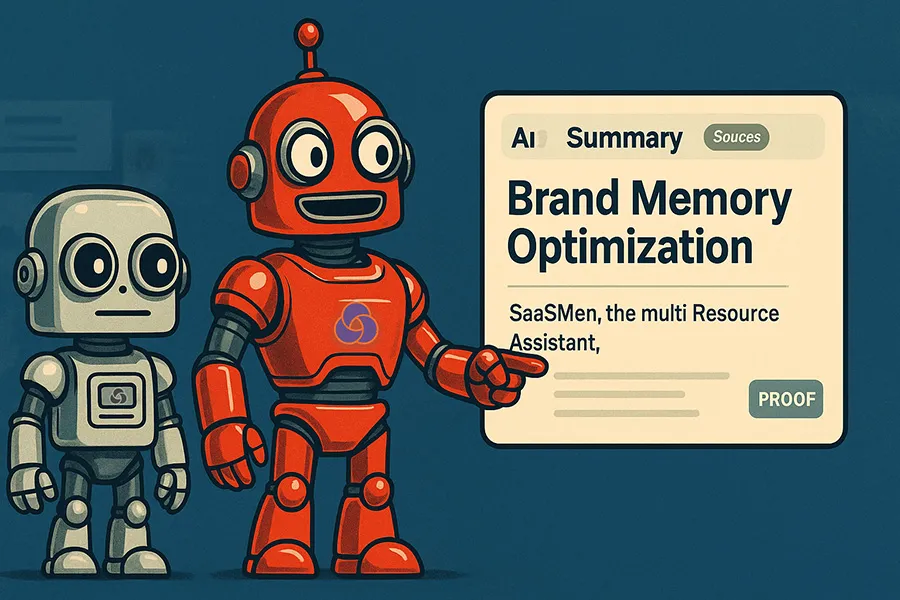
- AI answers reward repeatable labels and proof that match the question
- Small brands win by feeding consistent facts that can be cited in a sentence
- Work from three pillars named facts helpful formats trusted signals
Why brand memory matters in generative answers
Old search returned a pile of blue links. Today many results show a short narrative with a few sources. If your name sits inside that paragraph, discovery continues. If not, your work sits behind the curtain. Brand Memory Optimization focuses on feeding the answer box with the exact labels, facts, and proof that make your shop an easy citation.
Think of the answer engine as a busy host taking notes. It repeats what is simple, stable, and backed up. Consistent labels across your site and listings help that host write your name without doubt. Plain language helps your fact land inside a single sentence. Clear proof makes the citation safe to include.
People first content wins when it gives helpful and reliable information that fits the question. Google Search documentation
Small brands have an edge. You know your town and your buyer. With a few steady habits your name can appear in AI answers for local tasks where trust and proximity matter.
Three pillars of small brand memory
Every fact worth repeating needs a stable label. Use the same wording each time so the engine can match your pages together. Write the key fact once in a short sentence that a model can quote cleanly.
- Service name followed by the main value in one line
- Price or range if it helps a quick decision
- Coverage area written as city and nearby areas in a single line
- Hours and response time with a plain time format
Answer engines like content that maps to common tasks. Use recurring blocks so the engine can spot and reuse them.
- How to choose blocks that state when your service is the right fit
- Quick list of steps for a common job with who does what
- Reader friendly FAQ with short answers and clear terms
- Simple comparison table that links to proof on your site
Trust grows when claims match visible proof. Give the engine links to source your claim in one hop.
- Customer story pages with a line that states the outcome
- Photo or video with a short caption that matches the claim
- Third party badges and local groups with live links
- Clear contact page with owner name and street address
These pillars turn your site into a reliable source for narrative answers across SEO AIO GEO AEO and SXO goals.
Local examples with simple wins
Write a one line claim that the answer engine can quote. Repeat the same wording on your home page service page and Google Business Profile.
- Brake repair same day for most models in Grand Ledge
- Free check in ten minutes no appointment needed
- Two year warranty parts and labor with clear terms page link
Add a tiny FAQ. Each answer should fit in a short paragraph so it can stand alone inside an AI box.
Create a recurring block named Today at the counter. List three items with a short description and a nearby neighborhoods line. Publish the block as a small fragment on the home page and as a feed. Models can quote that list when people ask what is fresh today near me.
Create a steps block that states how booking works. Keep it to five lines. This small pattern helps the engine answer how to book without guessing.
- Create one sentence for your main claim and paste it into every page that relates to it
- Give that sentence a short proof link that uses the same label across pages
- Check that your contact page repeats the owner name street address and phone in the same order
Simple scorecard for small brand memory
Use this table to spot gaps. Aim for yes on each line. This takes minutes and pays off in repeated mentions inside AI answers.
| Signal | What to look for | Yes or No | Where to fix |
|---|---|---|---|
| Named claim | One sentence that states your core value using the same wording site wide | Home page service pages footer | |
| Proof link | Link labeled Proof or Results that matches the claim wording | Case study page photo caption | |
| Local line | Coverage area written as city and nearby areas in one line | Header footer Google Business Profile | |
| Short FAQ | Four to six questions with answers under one hundred words | FAQ page and related service pages | |
| Steps block | Five steps that show how to buy book or schedule | Home page and service page sidebars | |
| Owner facts | Name street address phone hours and response time in one place | Contact page and footer |
These short prompts produce clean blocks that answer common buyer tasks. Paste them into your AI tool and edit the bracketed parts.
Write one sentence that a shopper could quote to describe [YOUR SHOP] in [CITY]. Limit to 18 words. Include the main value and a simple proof phrase.Create a five step block named How booking works for [SERVICE]. Use very short sentences. End with a link label that says Proof and a matching short URL path suggestion.Draft a four question FAQ for [SERVICE] in [CITY]. Each answer must fit in 90 words and stand alone inside an AI answer box.How small and local brands survive in generative search
Survival means your name appears inside the answer box at the moment of choice. You do not need a giant budget. You need a repeatable system that feeds named facts helpful formats and trusted signals in a steady rhythm.
Think in buyer moments like quick fix today price check now first time setup or urgent safety concern. Shape one tiny block for each moment. Put that block on the right pages with the same labels. This teaches the engine where your shop fits and when it should mention you.
Short repeatable blocks work better than random long posts. A weekly Today at the counter block a monthly proof story and a seasonal steps update keep your signals fresh without heavy work.
Make citations easy by giving clear anchors for the model to cite. Use a short proof link and a caption that repeats the claim. When the answer includes your line and the proof link your name moves from unknown to trusted.
- Write your one sentence claim and add it to your header service pages and footer
- Create one proof page with a matching caption and link label
- Publish a steps block and a short FAQ for your top service
Frequently asked questions
Short answers help your pages appear in AI boxes and help real people finish tasks. Use these as a template for your own site.
What is brand memory optimization
It is the practice of feeding answer engines with consistent labels short facts and proof so your brand is easy to quote inside narrative results. The focus is on repeatable patterns across your pages listings and social posts that match common buyer tasks.How is this different from old school SEO
Old search rewarded long lists of links and broad posts stuffed with many terms. Brand memory work favors short reusable blocks that answer a single task in clear language with a proof link. The goal is to be quoted inside the answer box not only to rank a page.Where should a small shop start
Start with one sentence that states your main value and publish it in the same words on your home page service pages and footer. Then add one proof page with a photo caption that repeats the same wording. Finish with a short FAQ and a steps block for your top service.What should I avoid
Avoid changing labels across pages writing long paragraphs without a single quotable line and hiding proof behind vague words. Do not post once and stop. Consistency over time builds memory for both people and models.Common traps to avoid
- Changing your main claim wording across pages or listings
- Posting long updates with no single quotable line
- Using vague labels that models cannot match to a task
- Hiding proof behind forms or slow files
Pick one pattern and repeat it across your site and profiles. That rhythm is how your brand becomes easy to cite.
Glossary
- SEO
- Work that helps pages show up in search results
- AIO
- Shaping content so AI systems can read and reuse it with fewer errors
- GEO
- Designing pages to be cited by generative engines inside narrative answers
- AEO
- Writing direct concise answers that appear in zero click results
- SXO
- Making the reading and buying experience feel smooth fast and helpful