How Do AI Mode Rankings Work in Google?
Instead of ranking web pages by backlinks and keywords alone, AI ranking systems interpret meaning, reputation, and the likelihood a result answers intent accurately, especially for local and industry-specific searches. Google's "AI Mode" is reshaping how visibility, authority, and local context are measured.
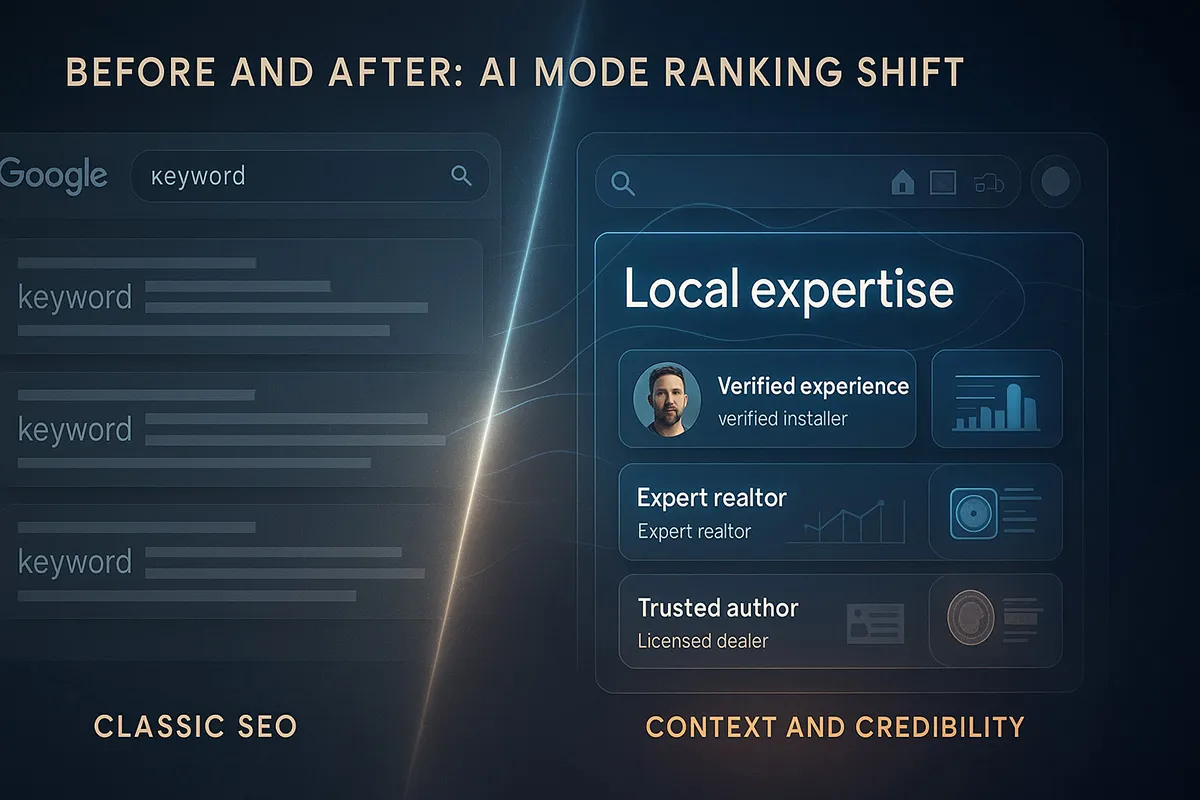
Why AI Rankings Differ from Classic SEO
AI Mode uses transformer-based contextual models similar to those in ChatGPT or Gemini to evaluate the entire meaning of content. Instead of counting how often a keyword appears, it asks whether the text demonstrates experience, expertise, authority, and trust. In AI Mode, the algorithm reasons through each section to determine how clearly it satisfies intent.
- Content is scored on topical coherence, citation accuracy, and brand reputation.
- Local proximity and business identity contribute to "trust alignment."
- Answers that match voice-search phrasing or AI-overview prompts receive priority.
Google's Search Liaison (2025) stated that AI Mode uses a mix of large-language inference and quality raters to confirm expertise signals before surfacing a brand result.
Industries Seeing Visible Shifts
AI Mode results vary by vertical, especially where local expertise or technical specificity matters. Mid-sized businesses in community-driven sectors are seeing the largest positive adjustments.
Local Real Estate
Agents publishing clear market commentary with pricing data and neighborhood nuance are now appearing above aggregator portals. For instance, "Homes for sale in Lansing MI under $400k" now favors agents providing firsthand insight instead of generic IDX feeds.
Home Flooring Retail
Retailers that include installation videos and customer-authored reviews are surfacing ahead of big-box competitors. AI Mode recognizes narrative authenticity, photos from actual jobs and local testimonials, as stronger proof than syndicated product specs.
Automotive Aftermarket
Manufacturers such as those in suspension or air-management systems are gaining ground when publishing installation guides, torque specs, and fitment charts. AI systems detect hands-on authority and rank those pages higher than e-commerce resellers repeating catalog data.
Numismatics
Coin dealers who write about provenance, grading accuracy, and historical context are outranking marketplaces. AI Mode correlates specialist vocabulary ("die crack," "mintmark placement") with genuine expertise, raising visibility for scholarly dealers.
Signals Google's AI Measures
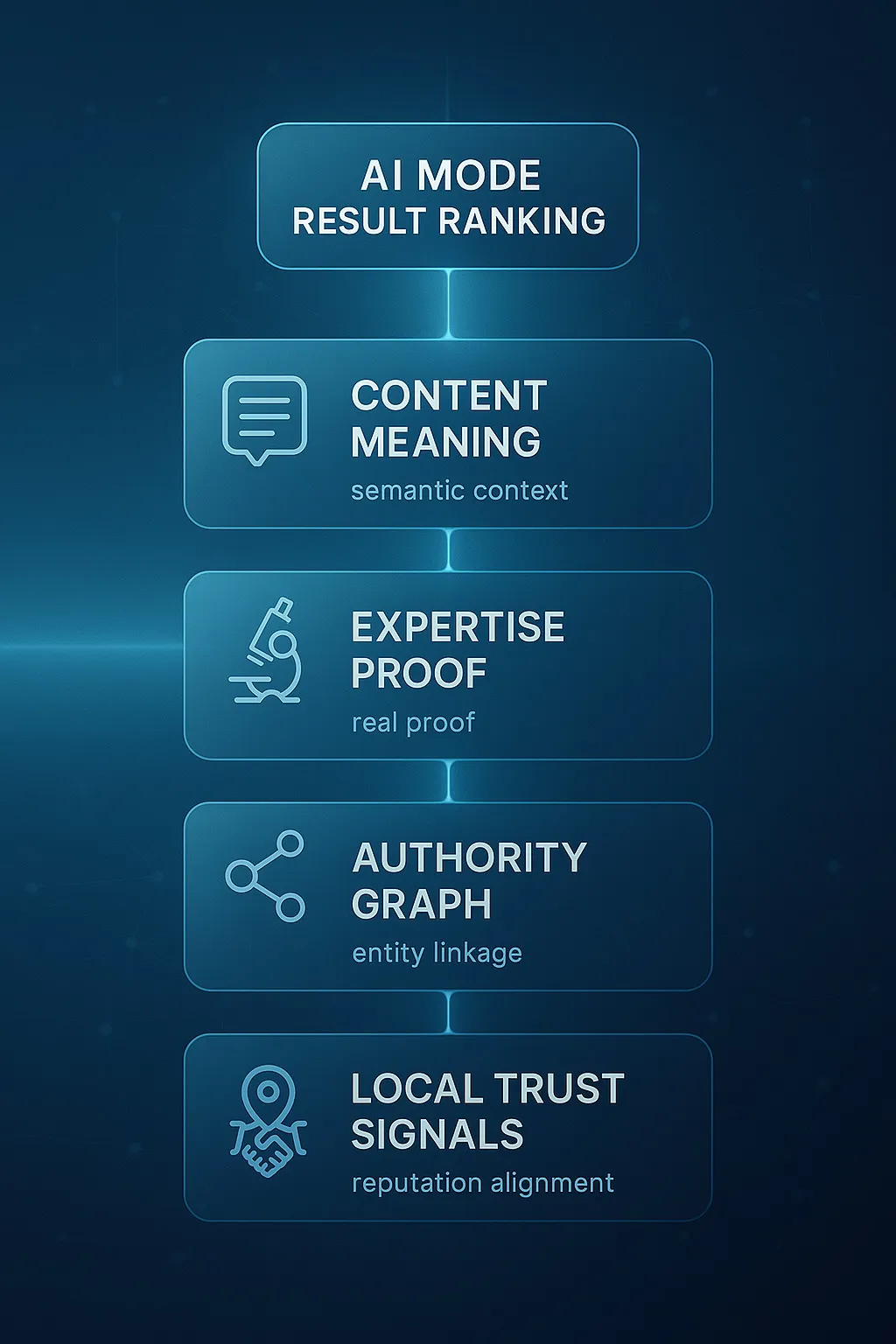
The shift toward AI Mode means traditional ranking factors like backlinks are weighted alongside contextual trust cues. Each cue is validated against factual precision and engagement data.
- Experience Proof
- Photos, videos, and customer examples tied to the author's local identity.
- Authority Graph
- Structured citations across Google Business Profiles, LinkedIn, and niche directories.
- Relevance Density
- How consistently the content stays on-topic relative to intent without overstuffing.
- Interaction Depth
- Dwell time, meaningful scroll, and click-through to reference assets or calls to action.
- Use schema markup for
FAQPageandLocalBusiness. - Publish original visuals or transcripts of real work.
- Reference verifiable data (year + source).
- Answer "how" and "why" questions clearly within 50-120 words.
Strategic Steps
Businesses that invest in structured data, real authorship, and conversational clarity will win in AI Mode. It is less about gaming algorithms and more about making content interpretable by both people and language models.
Prompt-Based Content Testing
Teams now test articles by running them through ChatGPT or Gemini prompts such as:
"Which local flooring company in Lansing provides expert advice on subfloor prep?"If your business appears in those generative answers, your AEO alignment is working. If not, adjust your internal linking and local citations.
- Audit every service page for structured clarity and factual anchors.
- Consolidate duplicate local listings to strengthen brand memory.
- Run quarterly "AI Visibility Tests" simulating SGE and ChatGPT queries.
Frequently Asked Questions
Below are concise answers addressing common C-level questions about AI Mode visibility and local search impact.
What is Google's AI Mode?
AI Mode is Google's generative ranking layer that evaluates meaning, reputation, and local context to reorder search results beyond classic SEO signals.How do AI rankings affect small and mid-sized businesses?
They reward transparent expertise and verifiable experience. Niche businesses with original content and citations often outrank larger but generic competitors.Can E-E-A-T still influence AI Mode?
Yes. E-E-A-T remains the foundation. AI systems simply infer those qualities using semantic cues and cross-platform validation instead of manual raters alone.Which schema helps improve AI Mode rankings?
UseArticle, FAQPage, and LocalBusiness schema together to feed clear entity relationships to AI interpreters.