How ChatGPT and OpenAI Work Together in Plain Language
Most people know ChatGPT as the friendly chat box on their screen, but fewer understand what powers it behind the scenes. This article breaks down the relationship between ChatGPT and OpenAI in the simplest way possible using real world comparisons.
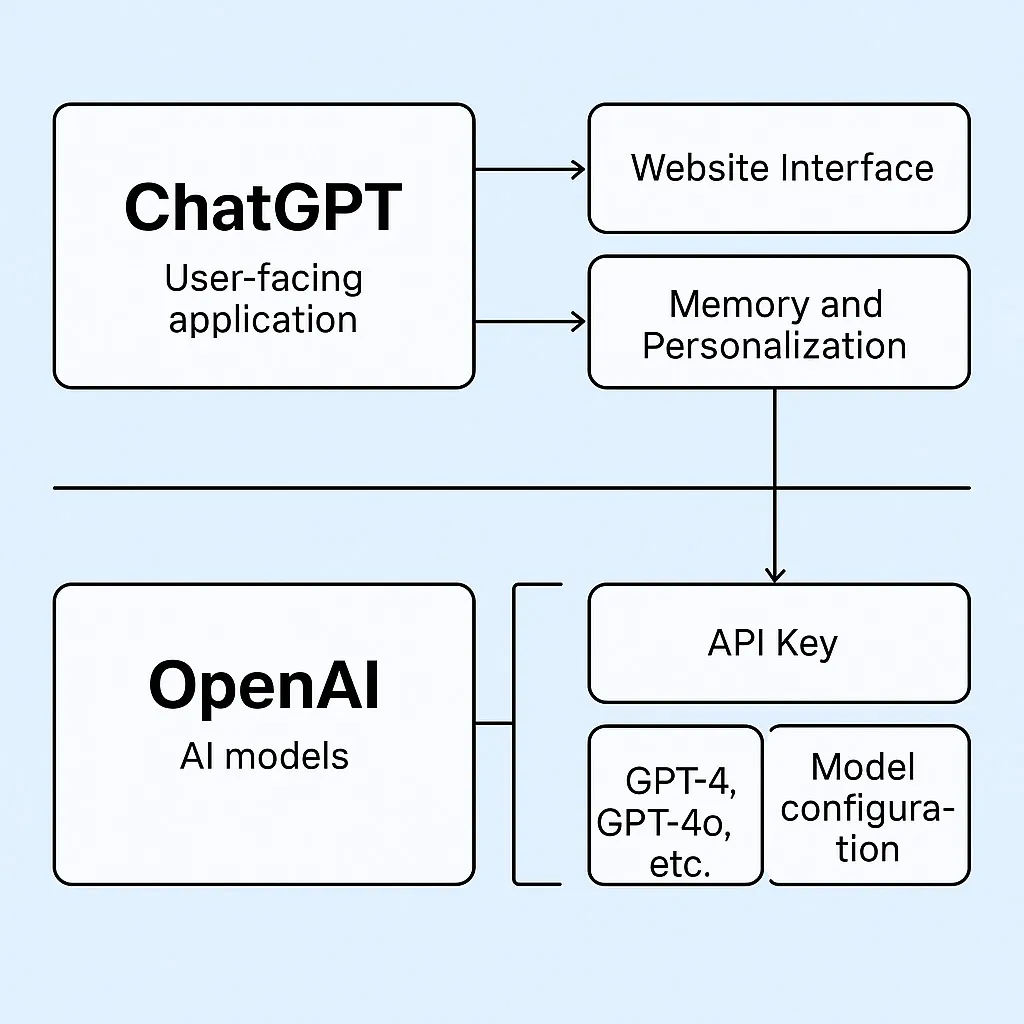
What OpenAI Does
OpenAI is the organization that builds and maintains the core intelligence models such as GPT-4, GPT-4o, and GPT-5. These models are trained on vast amounts of text and can generate meaningful responses to almost any question. They form the foundation that other tools use to create applications and interfaces.
You can think of OpenAI as the brain. It is where the learning happens, where understanding is processed, and where every sentence starts before it reaches you. Without OpenAI, ChatGPT would have no mind behind its words.
What ChatGPT Does
ChatGPT is the application that sits on top of OpenAI’s technology. It provides the interface, chat history, memory, and customization that make it feel personal. This is the part most people see and use daily. The way it remembers prior topics or shows a friendly layout all happens here, not in the model itself.
In short, ChatGPT is how people communicate with OpenAI’s models. It is the bridge that turns advanced language processing into a comfortable conversation.
How API Keys Connect It All
The connection between applications like ChatGPT and OpenAI’s models happens through something called an API key. This key acts like an access pass that tells OpenAI who is sending a request, what model they want to use, and how the output should behave. Developers use API keys to build new tools that rely on the same models as ChatGPT.
The API key itself doesn’t change the intelligence of the model. It only grants access. Any specific tuning or personalization happens within the app or through separate training files, not through the key alone.
Industry Analogy Tables
The easiest way to grasp this relationship is to compare it to industries you already understand. Each field has an engine that does the heavy lifting and a layer that makes it practical and usable.
Automotive Analogy
| Component | Role | Analogy |
| OpenAI Models | Core Intelligence | The engine that provides power |
| OpenAI API | Interface | The fuel line connecting systems |
| API Key | Authentication | The ignition key that starts the system |
| ChatGPT App | User Experience | The dashboard and controls drivers use |
| Custom GPTs | Personalization | A tuned engine setup for specific driving needs |
Real Estate Analogy
| Component | Role | Analogy |
| OpenAI Models | Core Knowledge | The property database containing all listings |
| OpenAI API | Connector | The MLS feed that provides the data stream |
| API Key | Access Control | The realtor’s login credentials |
| ChatGPT App | Interface | The client portal where buyers view homes |
| Custom GPTs | Specialization | Neighborhood filters or local guides tailored to each buyer |
Flooring Sales and Installation Analogy
| Component | Role | Analogy |
| OpenAI Models | Foundation | The raw flooring materials in the warehouse |
| OpenAI API | Connector | The delivery truck that moves materials to the site |
| API Key | Authorization | The delivery manifest that proves it belongs to you |
| ChatGPT App | Interface | The showroom that helps customers choose their style |
| Custom GPTs | Customization | Design visualizers or pattern matchers for specific rooms |
Concrete Floor Coating Analogy
| Component | Role | Analogy |
| OpenAI Models | Core Engine | The concrete foundation itself |
| OpenAI API | Conduit | The sprayer or roller applying the coating |
| API Key | Control | The trigger that starts the flow |
| ChatGPT App | Finish Layer | The glossy surface customers walk on and see |
| Custom GPTs | Finishing Options | Color, texture, and pattern variations that make each job unique |
Frequently Asked Questions
These quick answers help clear up the most common points of confusion for professionals exploring AI tools.