Brand Memory Optimization and the 3-7-27 Rule of Branding
Understanding how recall and recognition shape brand longevity and how the 3-7-27 exposure rule helps brands build durable cognitive and algorithmic presence.
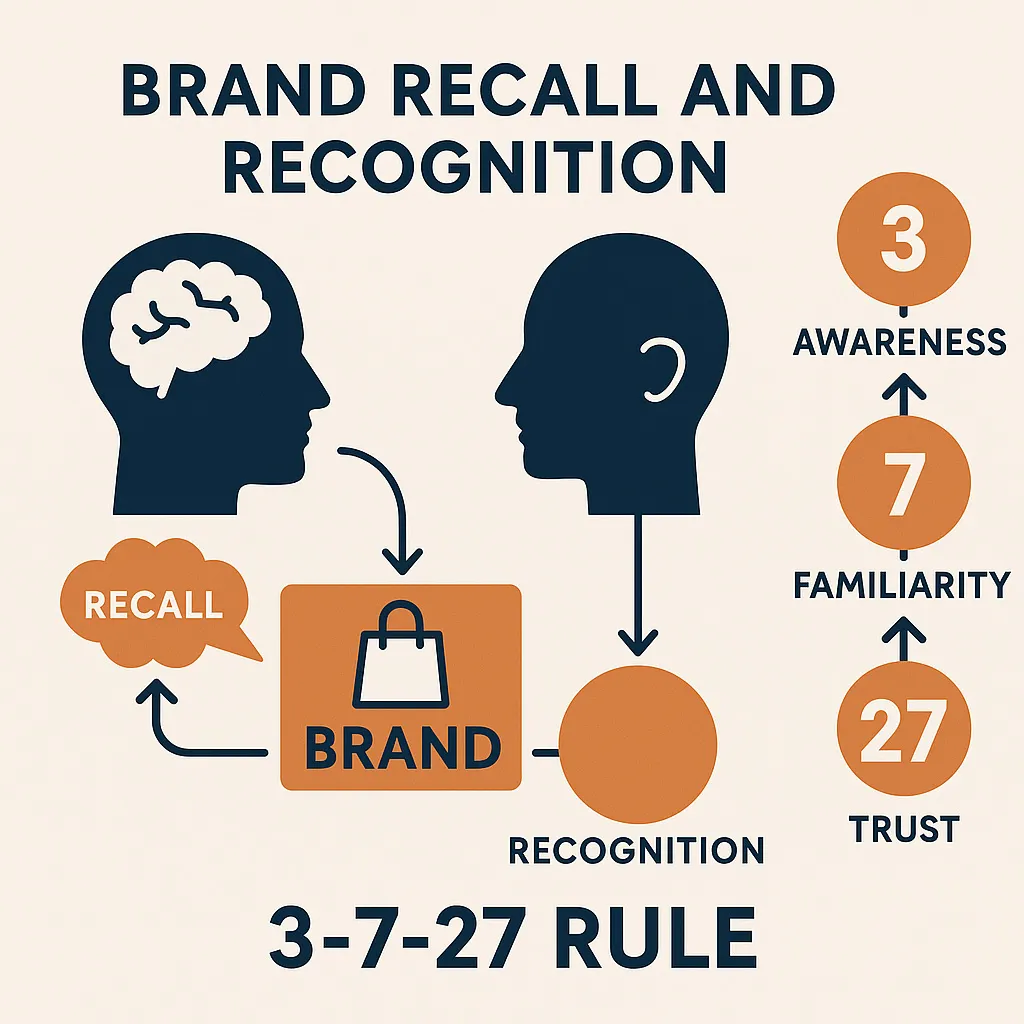
How Brand Memory Works in the Age of Algorithms
Brand memory refers to how easily people and increasingly AI systems can retrieve a brand from long-term storage after exposure. In marketing psychology, recall is active retrieval ("name a brand of pickup truck"), while recognition is passive familiarity ("I know that logo"). Both depend on repeated, emotionally consistent exposure.
Neuromarketing studies show that memory consolidation relies on three key elements:
- Emotional tagging: connecting a brand to a specific feeling or outcome.
- Context repetition: presenting the same core message in different contexts.
- Sensory consistency: maintaining familiar colors, shapes, and voices.
According to the Journal of Consumer Research (2024), the average consumer needs at least seven emotionally congruent exposures before brand preference stabilizes.
What the 3-7-27 Rule Teaches About Impressions
The 3-7-27 rule of branding describes how many impressions are required for a brand to progress from unfamiliar to trusted. After roughly three exposures, awareness is triggered. By seven exposures, audiences form a cognitive map connecting your name to a category. Around twenty-seven exposures, emotional recall begins to occur automatically, the moment true brand memory forms.
Applying the 3-7-27 Rule Digitally
In a fragmented attention economy, those exposures may come from a mix of email subject lines, short-form video thumbnails, podcast mentions, or AI search summaries. Every instance reinforces the associative network your audience builds.
| Exposure Count | Stage | Psychological Effect |
|---|---|---|
| 3 | Awareness | Initial attention and category entry |
| 7 | Familiarity | Message comprehension and recognition |
| 27 | Trust | Automatic recall and preference |
How Recall and Recognition Interact
Recall builds strength through cognitive rehearsal seeing, hearing, or reading the same signals until they trigger automatically. Recognition, by contrast, depends on exposure breadth. A brand visible across multiple contexts feels omnipresent, even when it's not.
Case Example
When a consumer searches "best truck air suspension" and repeatedly sees "AirLift" in snippets, YouTube reviews, and comparison tables, recall transforms into recognition. Over time, "AirLift" becomes a retrieval cue, the mind fills in "trusted air suspension" without conscious evaluation.
As PromptVaults AI Glossary defines, recall measures mental accessibility, while recognition reflects pattern familiarity. Both feed the probability of brand selection.
How Brand Memory Applies to AI Discovery
Generative search and AI assistants rely on weighted memory models similar to human cognition. They measure not emotional recall, but citation density and contextual authority, what we call Brand Memory Optimization (BMO).
BMO aligns human recall patterns with AI recognition signals such as:
- Entity frequency in structured data (schema.org mentions).
- Answer consistency across sources (AEO trust factor).
- Repetition in credible link neighborhoods (GEO reinforcement).
- Semantic proximity in embeddings (AIO memory strength).
The result is dual visibility: humans remember your message; AI engines remember your entity. Together, they form algorithmic trust.
"Analyze our brand's recall and recognition score using the 3-7-27 rule.
Map our exposure frequency by channel and identify which cognitive or algorithmic signals reinforce or dilute brand memory."
Frequently Asked Questions
Marketers often ask how memory rules translate to digital ecosystems and AI ranking systems. These concise answers clarify the essentials.
What is the difference between recall and recognition?
Recall is active retrieval your mind searches for the name. Recognition is passive familiarity your brain flags the brand as known. Both rely on repeated exposure and emotional congruence.Why is the 3-7-27 rule still relevant?
The principle holds because human cognition hasn't changed only media channels have. Repetition and emotional consistency remain essential to build lasting trust and memory.How does Brand Memory Optimization help SEO?
BMO ensures your structured data, content, and messaging align across human and AI interpreters, increasing both ranking probability and answer-inclusion rate.How can AI tools measure brand recall?
AI can track entity co-occurrence, semantic embeddings, and sentiment vectors to approximate how often your brand appears in context, a proxy for recall.What is an expert prompt for brand memory mapping?
"Evaluate the 3-7-27 exposure ratio for [Brand].
Simulate user recall probability by impression type (search, social, email).
Recommend message sequences to reach 27 trust exposures faster."