What's the Difference Between ChatGPT and OpenAI?
Many people use the words "ChatGPT" and "OpenAI" interchangeably. In truth, they are two connected parts of one system, one provides the brainpower, the other makes it usable. This article explains their roles, how they interact, and why understanding that difference matters for any business exploring automation or AI-driven tools.
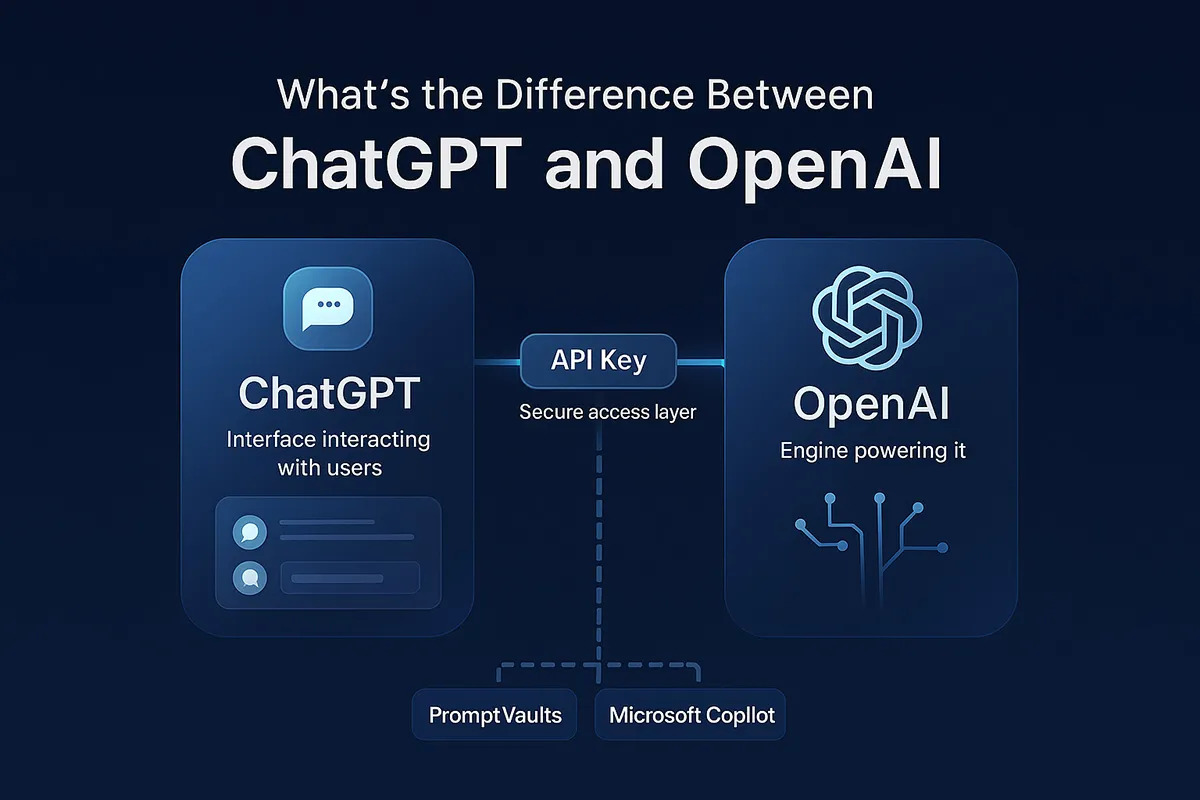
OpenAI as the Engine
OpenAI is the company that builds and maintains the language models that make tools like ChatGPT possible. Its models, including GPT-4, GPT-4o, and GPT-5, serve as the core engines that process language, interpret meaning, and generate responses. They are the foundation behind all of OpenAI's applications and APIs.
Think of OpenAI as the manufacturer of an advanced engine. It's not what you directly drive, but without it, nothing moves. The engine's precision, capacity, and efficiency define what can be built on top of it. The better the engine, the more refined the user experience becomes.
OpenAI designs and trains large-scale models that can understand and generate human language, making them accessible to developers and end users through its products and APIs.
OpenAI's role goes beyond engineering. It manages data safety, scalability, and ethical guidelines, ensuring that its models perform consistently across industries, whether someone is building a chatbot, an internal document assistant, or a workflow automation tool.
ChatGPT as the Interface
ChatGPT is the accessible interface built on OpenAI's models. It adds the human-facing layer, the chat window, file upload system, and memory features that allow you to have an ongoing conversation. In other words, ChatGPT is the product that lets anyone use OpenAI's technology without writing a single line of code.
When someone types a message into ChatGPT, the app formats that input and sends it to OpenAI's model through a secure connection. The model generates a response, sends it back, and ChatGPT displays it in a readable, conversational format. That back-and-forth happens in seconds, creating the illusion of a single, thinking entity, but behind the scenes, it's a clear division of tasks between two systems.
Most professionals interact with ChatGPT as the visible layer. It's intuitive, conversational, and requires no technical setup. But it doesn't exist on its own, it's a refined presentation of OpenAI's deeper technology.
The API Key Connection
The link between ChatGPT and OpenAI is managed through a secure system known as an API, short for Application Programming Interface. When developers or companies want to build tools that use OpenAI's models, they authenticate through an API key. This key functions like a digital ID badge, confirming who's using the system, what model they're accessing, and how much data is being processed.
In ChatGPT, that process happens automatically. For businesses or developers building on their own, they use OpenAI's API directly. The same key concept applies whether you're using PromptVaults for content optimization or integrating OpenAI into a CRM for customer support automation. The API is the bridge that makes the brain available to every other system.
Importantly, the key doesn't "tune" or personalize the model itself, it simply unlocks access. Customization happens at the application level, where the system decides how to prompt, instruct, and structure responses based on the user's needs.
Universal Analogy Table
Across industries, the same structure repeats itself, an engine that does the work, a connector that transfers power, and an interface that people use. The following table summarizes that concept in everyday language.
| Component | Purpose | Real-World Analogy |
|---|---|---|
| OpenAI Models | Provide the intelligence and reasoning | The engine that powers the system |
| OpenAI API | Transfers data between engine and interface | The wiring or fuel line that moves energy |
| API Key | Authenticates access | The ignition key that starts the process |
| ChatGPT | Delivers a user-friendly experience | The dashboard and controls that people interact with |
This same idea applies whether you're managing real estate listings, flooring design tools, or an AI-driven sales dashboard. The brain (OpenAI) is the same, only the interface (ChatGPT or your own app) changes to fit the context.
Why This Difference Matters
Understanding where ChatGPT ends and OpenAI begins helps business leaders make smarter decisions. It clarifies what part of the technology they're truly using and where control or customization is possible. If you're automating workflows, building chat assistants, or connecting multiple systems, this difference determines how flexible your solution can become.
In practice, using ChatGPT is like buying a finished product that's ready to use, stable, and easy. Using OpenAI directly through its API is like sourcing the parts to build your own version. Both are valuable, but they serve different goals depending on whether you want simplicity or full customization.
Frequently Asked Questions
Below are short answers to the most common questions people ask when learning how ChatGPT and OpenAI relate to each other.